
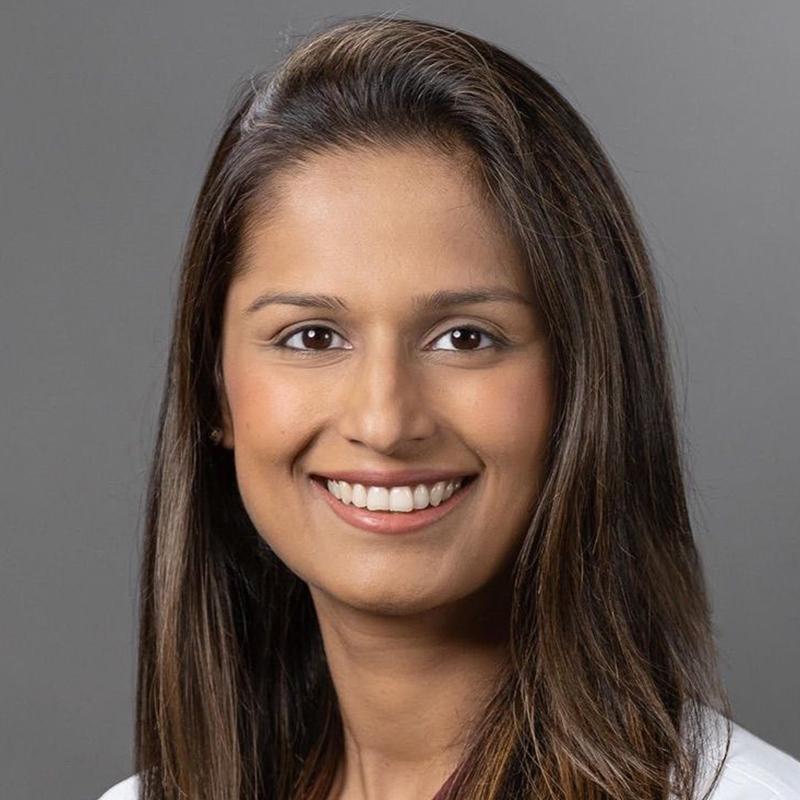
Sana Syed, MD, MSCR, MSDS, a physician-scientist at Duke University School of Medicine, Department of Pediatrics, has received the National Institutes of Health (NIH) K24 Midcareer Investigator Award. Funded since August 2025, the award recognizes her leadership in patient-oriented research and her devotion to mentoring the next generation of clinical investigators.
The K24 award is among the NIH’s most selective career development grants. It supports established researchers who demonstrate exceptional mentorship and helps expand the pipeline of talented physician-scientists capable of translating discoveries into advances in patient care.
For Duke, the award represents more than an individual achievement. It also underscores the institution’s growing role in moving data-centric discoveries from research settings to the bedside, so patients can directly benefit.
“Awards like the K24 are critical because they help cultivate future leaders in clinical research,” Syed said. “My work will focus on training investigators to harness large-scale data and advanced computational tools. Together, we can generate discoveries that lead to more personalized and effective treatments for patients.”
Bridging Data Science and Patient Care
The award will help address a pressing challenge in medicine: predicting which patients will develop severe disease and which will require minimal treatment. This issue is particularly significant in gastrointestinal and immune-mediated conditions.
Accurate forecasting of disease progression remains an unmet need across many gastrointestinal and immune-mediated conditions. The ability to identify high-risk patients at the time of diagnosis could improve care by enabling clinicians to intervene earlier and to customize treatment strategies to specific needs.
Syed’s program will train junior clinical investigators in advanced data science approaches that integrate massive, complex datasets – often referred to as “multi-omic” data – to uncover biomarkers, therapeutic targets, and predictive models.
The award’s research and training program includes three primary aims:
- Develop innovative data science tools, including genome-scale metabolic network reconstructions and digital histopathology platforms.
- Integrate patient-derived biospecimens and health data with multi-omic datasets to classify disease subtypes and identify novel biomarkers in pediatric and adult gastrointestinal diseases.
- Establish a multimodal biospecimen repository linked to electronic health records and multi-omic data to support future medical research.
Together, these efforts aim to improve clinicians’ ability to predict disease outcomes and inform personalized treatments that advance patient health.
Building the Future Research Workforce
A keystone of the K24 award is mentorship. Syed will train junior clinical investigators in advanced methods that combine data science, genomics, and clinical research. The goal is to expand the number of physician-scientists capable of applying computational methods to complex patient-oriented research questions.
“Training is one of the most powerful ways to accelerate scientific progress,” Syed said. “When investigators gain the skills to integrate computational methods with clinical research, the impact extends far beyond a single project.”
Her mentees are Lianna Wood, MD, Boston Children’s Hospital; Dana Neugut, MD, Children’s Hospital of Philadelphia; Nazanin Moradinasab, PhD, University of Virginia; Lauren Klein, MD, Vanderbilt University; Shahzaib Khan, MD, SUNY – Downstate; and Sharmilaa Babu, MD, Duke University.
Through the program, trainees will learn to analyze large-scale patient datasets to identify biomarkers and therapeutics, predict disease trajectories, and develop more individualized treatment approaches.
“Coming from a predominantly clinical training background, learning data science and multi-omics has opened an entirely new way of thinking about research. It's been exciting to see how these tools can help answer clinically meaningful questions and ultimately improve care for children. Dr. Syed's mentorship has made this learning journey both approachable and inspiring, and I'm excited to continue building these skills in my pediatric IBD research,” said mentee Sharmilaa Babu, MD, a 3rd-year pediatric gastroenterology fellow at Duke and also a trainee at the Duke Clinical Research Institute (DCRI).
Leveraging Duke’s Research Infrastructure
The award will also draw heavily on Duke’s extensive research ecosystem, including resources from the Duke Clinical Research Institute (DCRI), one of the world’s leading academic research organizations.
Syed’s training program will utilize data generated through NIH-funded studies, foundation-supported projects and three large clinical trial programs conducted through the DCRI. These activities collectively provide access to a large repository of patient-derived health information and biological samples.
Among the available resources are more than 4,500 gastrointestinal biopsy samples from over 750 participants, providing a rich foundation for projects focused on infectious and immune-mediated diseases.
The combined effort of these programs will also connect trainees with experts across multiple disciplines, providing technical and intellectual support while exposing them to a broad range of research methodologies.
A Vision for Precision Medicine
The K24 award also aligns with Syed’s broader research vision: bringing the strength of big data, computation, and genomics directly to patient care.
That vision is reflected in her recent work, published in Cell Systems, titled “Metabolic network analysis of Crohn’s disease reveals sex- and age-specific cellular phenotypes.” The study used advanced computer-based modeling to uncover biological differences among Crohn’s disease patients, supporting more individualized treatment approaches.
In the future, Syed and her team aim to build predictive models that identify which patients are likely to respond to anti-TNF therapies – a major class of treatments used in inflammatory bowel disease.
Success in that effort could help clinicians select the right therapy earlier, reducing trial-and-error treatment, and advancing patient outcomes.
Developing Research from Discovery to Impact
While the K24 award recognizes Syed’s accomplishments as a researcher and mentor, its greater importance lies in strengthening the clinical research workforce and accelerating the translation of scientific discoveries into patient care.
By combining mentorship, cutting-edge data science, and access to extensive patient-derived datasets, the program aims to train a new generation of investigators to solve some of medicine’s most challenging problems.
As health care increasingly embraces precision medicine, initiatives like Syed’s are helping ensure that scientific advances do not remain confined to research settings but instead reach the patients who stand to benefit most.