
Alumni Spotlight: Jeffrey Ferranti
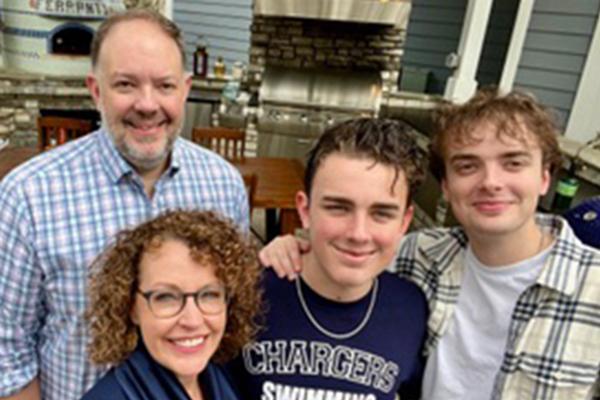
Jeffrey Ferranti, MD, MS, is currently the senior vice president and chief digital officer at Duke Health. He has come a long way from his med school days of designing websites for rock stars and is now a renowned figure in health care technology. Dr. Ferranti is leveraging his expertise to revolutionize the field of pediatrics and improve the overall health care experience through innovation and AI.
Here is a recent Q&A with him:
How did you get involved in IT?
I grew up in New York but went to McGill University in Montreal for medical school. I went there for a couple of reasons. The biggest one was the educational philosophy of William Osler, McGill's founder. The curriculum allows you to do one year in the classroom and then three years at the bedside, which was appealing to me. I ended up being one of about 25 Americans in my class at McGill, with about 75 Canadians. There, I met a neonatologist at the Royal Victoria Hospital named Bob Usher, MD, who interested me in IT and informatics. He created the largest database in the world for newborns, called the MOND database. After doing research with him, I got on the path of IT and neonatology.
I also worked for Sony Music during college and medical school, where I helped create web pages for new artists. I would meet with the musicians and build their web pages. It was at the beginning of the Internet and during the alternative and grunge era of music – so I had a unique opportunity to meet groups like Pearl Jam, The Spin Doctors, and Alice in Chains. I took that interest in technology into medicine. After I completed my pediatrics training at Duke, I stayed to do a fellowship in neonatology. Ron Goldberg, MD, our division chief at the time, believed in the value of information technology and sent me to Duke's Pratt School of Engineering to get a master's degree in medical informatics. And it just evolved from there.
As a resident and fellow at Duke, how did you think that shaped your career?
I've been at Duke for 24 years. Duke has made my career. I have had some truly amazing mentors along the way who believed in me and invested in me. There are many who have been influential in my life, including Ron Goldberg and David Tanaka, MD. Also, Ed Hammond, MD, who is basically the grandfather of medical informatics and created the first electronic health record ever, happens to be at Duke and was one of my mentors. That time during my residency and fellowship introduced me to many great people who supported me as I progressed in my career.
How did Duke change your global perspective?

I became more involved in global issues as a young faculty member. In particular, I had an opportunity to work with Duke and the National University of Singapore. We have Duke faculty members who work there, and I've had an opportunity to visit and work on collaborative technology projects together.
Technology is an amazing equalizer, and it is making the world smaller than ever. We can engage clinically across the globe using telehealth and other technologies. We're able to collaborate on education and research through video conferencing, and increasingly, language barriers can be overcome with AI. Having trained in Canada and worked with the Singapore system, I have great respect for both differences and the similarities in global medical practice.
What advice would you give yourself after all this experience?
The advice I would have given myself is that balance is really important. Balance at work. Balance at home. Balance in life.
When we're first starting, especially at an academic place like Duke, there are endless possibilities. It's easy to lose focus and become diffuse in what you're looking at. I tell all residents to "use your early years of residency and fellowship to explore broadly, but then use your later years to focus your efforts in a couple of places where you can have an impact."
Finding the right mentorship committee is the best way to do that. You have to aim high in picking your mentors because the folks who are more senior have achieved balance in their own careers. It's really easy to pick the people that you know, but it's been my experience that senior leaders, senior researchers, senior clinicians, and people who have reputations around the country and the world are willing to take on mentees if you go and talk to them and ask them. I would encourage trainees and junior faculty to find people who are in senior roles and have done impactful things and ask them to be your mentors because they will help you focus on where you're going in your career.
Are you mentoring anyone right now?
Yes, several people. I'm one of the faculty members and co-founders of our MMCI program, a clinical informatics program. We also have some informatics fellows who, in addition to their clinical fellowship, do a second fellowship in informatics. I always try to make myself available to my students and my staff in DHTS because our team is stronger when people feel supported. Outside of Duke, I have served as a mentor for the Cedars Sinai Technology Accelerator Program.
Where do you see the future of pediatric medicine?
I think AI is the most disruptive technology of a generation. It will impact everything we do in pediatrics, from how we care for our patients to how we educate our students and residents to how we do our research.
I take care of babies because if you can positively impact the health of a newborn, they have their whole life ahead of them. As pediatricians, we have an opportunity to care for patients before their health is impacted by lifestyle choices. So, pediatricians have an amazing ability to affect the outcome of a patient's life and their likelihood of having a healthy life. And AI is going to help us diagnose children earlier. It's going to help us intervene at the right time. It's going to help us follow a child's progress over time.
AI will be a game changer for pediatricians, and we're all lucky to be practicing pediatrics during a transformative time like this. I'm excited about the future.
Are there other ways you want to make an impact in pediatric medicine?
The scale of data is critically important to answer questions in medicine. Before the electronic health record, we only had data we could collect manually through chart reviews. With the EHR, we can now aggregate some data electronically, usually within the walls of single institutions.
But today, we're putting together data collaborations across institutions that span tens of millions of patients. And, importantly, it contains multi-modal data. So, by that, it is not just EHR data but also free text notes, genomic information, radiology information, digital pathology, and waveform tracings from monitors. Multi-modal data will be the key to asking and answering some of the most vexing questions we have in pediatrics. We're working on building a collaborative in the southeast that has three major academic institutions: Vanderbilt, Emory, and Duke. Our goal is to pool our multi-modal data together so researchers will be able to ask questions in a way that they've never been able to before.
Our partnership with Microsoft is bringing new technologies and analytics techniques to the table that we can use on these huge data stores that will be in the cloud. That's where we're going to have the impact. It's not just the AI; it's the AI plus the data, plus the type of data, plus the scale that we're trying to achieve. That's going to make a real difference.
Is there anything you want alums to know about AI?
Everyone needs to pay attention to AI now. This is not a passing fad. This is not news of the day. I think that generative AI is bigger than the Internet in terms of disruption. And we need to pay attention to it because it will impact our lives – professionally and personally. I think it's essential that we approach AI with a sense of ethics. We must assess these AI algorithms for things like bias and assess these algorithms for trustworthiness as well.
What advice would you give parents?
A balanced approach to technology is important in children's lives. You hear about screen time. You hear about social media. All these things could potentially have negative effects on kids. But banning technology altogether also puts children at a disadvantage later in life.
And so, families need to engage with technology through activities they do together. This will provide an opportunity for parents to understand how their kids interact with technology, but it's also an opportunity for parents to instill some of their digital values into the conversation with their kids. Increasing digital literacy, improving critical thinking skills around AI and technology, and providing a sense of ethics and how we use technology are not things kids will learn organically if left to their own devices with their mobile phones.
It's super important in 2024 for parents to actively prepare their kids for a future where technology will play a role in everything they do. If we have these digital tools, we must teach kids how to use them. We have a responsibility to help them develop interpersonally but also to fully leverage the incredible digital tools of the future.
How do you spend your time after work?
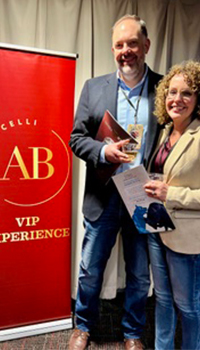
My wife, Tracy, a newborn nurse at Wake Med, and I like to travel together. We've traveled all over the US. We're increasingly traveling to Europe. Last year we went to Switzerland and Italy. This year we're going to France and Spain. It's great to see the cultural differences between the US and Europe, and we love to take in the culture and arts but also be foodies.
And I have two kids. My older son, Matthew, is a freshman at Carolina (who wants to do Health Management), and my other son, Carter, is a sophomore in high school.
In my free time, I love cooking. I built a wood-burning pizza oven in my backyard. So, my life quest is to make a better Neapolitan pizza than the time before.
I also play guitar – acoustic and electric, and I love music. I have very eclectic musical tastes from all those years working for Sony. They used to send me 300 or 400 CDs a month. I listen to everything from classical to jazz to R&B, hip hop, and metal because that's what I've been exposed to over all those years.
(Interviewer's note: Rock on! Dr. Ferranti. It was a great talk, and here's to the future of AI and the great things it will do for pediatrics.)