
Alumni Spotlight: Ian Paul
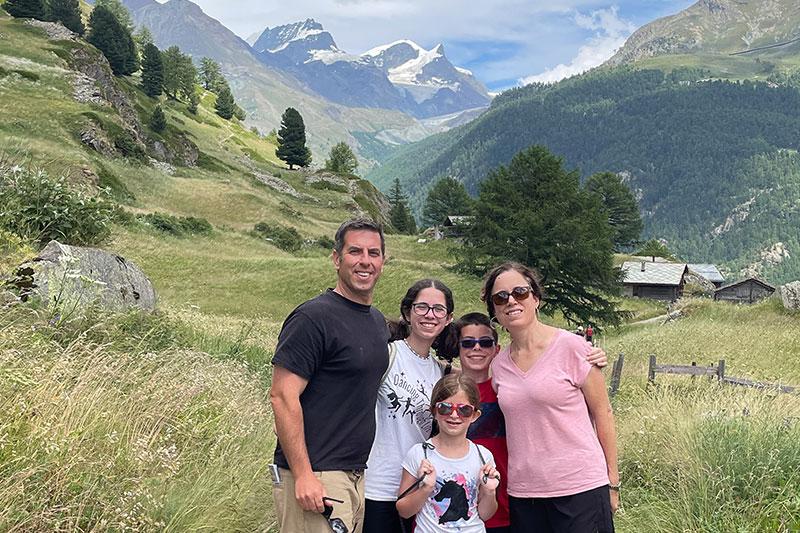
Ian Paul, MD, MSc, just celebrated 25 years since starting his residency at Duke in 1998. He has gone on to become the chief of the Division of Academic General Pediatrics and Vice Chair of Faculty Affairs at Penn State Hershey Children’s Hospital, create the Newborn Weight Tool (Newt), and find solutions for many common problems in child health that will shape the world of pediatrics for years to come.
Here is a recent Q&A with him:
How did you come to Duke?
Elaine Eyster, MD, was my mentor for four years in medical school at Penn State College of Medicine. She was a Duke alumnus, completing her undergraduate years in 1956 and then medical school in 1960. She believed in the excellence of Duke and said I should take a closer look at it for my residency. So I did. I later nominated her for the Duke Distinguished Alumni Award, which she received in 2011. Dr. Eyster was also instrumental in my return to Penn State as a faculty member.
How do you think your residency at Duke shaped your career?
First of all, there were two Deborah’s who shaped my career.
Deborah Squire, MD, and Deborah Kredich, MD
When I entered residency, I was pretty moldable, and I wasn’t sure what area of pediatrics I would ultimately pursue. I just knew I wanted to be a pediatrician. In my 2nd year of residency, I switched my resident continuity clinic preceptor to Dr. Squire. I thought her style fit with how I wanted to practice, and she challenged me in the right ways. She was always asking, “What is the evidence behind that?” I found the way she asked that question repeatedly refreshing, and it made me think about the type of care I wanted to deliver. She was a leader in evidence-based pediatrics, and that made me want to be in evidence-based pediatrics too. She was the perfect mentor for me at that stage of my career.
The second Deborah was Deborah Kredich, MD. She was a great advocate for her residents and held us to a high standard. I felt as a trainee that the entire department, health system, university, and residency program expected excellence. I was exposed to so many people at all different levels, from senior faculty and fellows to fellow residents, who are inspiring and amazing people. I got wisdom and pearls from Drs. Sam Katz, Rebecca Buckley and John Falletta when I worked with them. Danny Benjamin, MD, PhD, MPH (I was an intern when he was a first-year fellow in Pediatric Infectious Diseases) was and remains a strong influence on me and my career as an academic. Also, my co-residents. They were and are brilliant people. I developed so many strong and lasting friendships with them.
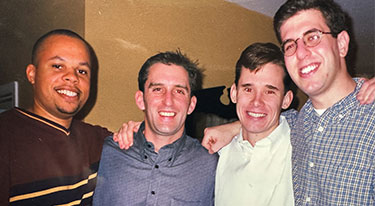
And lastly, there was a foundational item Duke taught me. When I was a 2nd year resident, I went to Durham Regional (now Duke Regional), and when I was there, I was the most experienced pediatrician in the hospital for much of the day. Once rounds were over, there were no faculty or fellows in the building, just ER doctors and the residents. This allowed me and my fellow residents to figure out things on our own and problem-solve. It was empowering. It was scary at first, but it encouraged me to have early independence and think things through. And it was an important experience to have.
What advice would you give after all this experience?
A mentor at Penn State once told me, “Chance favors the prepared mind.” (A quote taken from Louis Pasteur.) And it resonated. So I would say to be prepared for when opportunities come so you can seize them.
Tell Us about Newt.
Newt is the Newborn Weight Tool (www.newbornweight.org). It is like a growth chart but for newborn weight loss.
It was created because two questions come up in clinical practice for every well, term newborn.
1) How much weight are they losing during their newborn stay?
2) How jaundiced are they getting?
For jaundice, we have over 25 years of good charts to guide evaluation and management.
But for weight loss, the evidence was more anecdotal, with a conventional fear of babies losing 10% of weight. But as Dr. Squire would ask me, “What is the evidence behind that?” So, with a relative lack of evidence, I decided to study this and create the evidence. I partnered with colleagues to obtain a data set of over 160,000 babies and their hospital stay at Kaiser Permanente hospitals in California. From that, Newt was born.
We published a paper in the journal Pediatrics and launched www.newbornweight.org simultaneously so users could use the graphs themselves. Newt made it so that for the first time, clinicians, providers, and lactation advocates could see what a normal baby’s weight trajectory could be from the first days to the first months. Many millions of newborns around the world (nearly every country) have had Newt as part of their care since its launch in 2014. Further, many large health systems are incorporating it into their electronic medical records, and it is a standard of care for newborns for birth hospitalization into the first month. That has been pretty rewarding to experience.
What are you working on now?
I am still seeing patients and have been division chief for over 10 years, so I am quite involved in mentoring and supporting students and early career faculty. Nonetheless, there are two areas of research I am concentrating on right now:
1) Enrich project-
Since 20-25% of 2 to 5-year-olds are already overweight or obese in the US, we want to intervene before they get overweight, so I have been working on developing interventions over time that have been NIH-supported for the last 12 years.
My current project is part of the National Heart, Lung, and Blood Institute’s ENRICH consortium. This large multi-center study aims to improve multi-generational cardiovascular health, beginning with pregnant mothers and their children. The study will consist of a national cohort of low-income families with diverse populations from several centers around the US. We will be enrolling 3,000-4,000 pregnant people and, subsequently, their infants to improve their cardiovascular health. We are currently in the second year of this 7 year program.
2) Pediatric Therapeutics-
I want to continue my work in clinical trials on medication, especially over-the-counter (OTC) medications. I was the first to show that honey is better for coughs due to colds for children and provided evidence showing that OTC cold and cough medications are not safe or effective for children.
I have also been very fortunate to maintain a collaboration with Duke on the Pediatric Trials Network. I have been on the steering committee and worked with Danny Benjamin, MD, PhD, MPH, Brian Smith, MD, Kanecia Zimmerman, MD, MPH, and now Rachel Greenberg, MD, MHS, as it has evolved with different leaders. I have been lucky to participate in this groundbreaking network that has improved the evidence and labeling of drugs that we use to treat children.
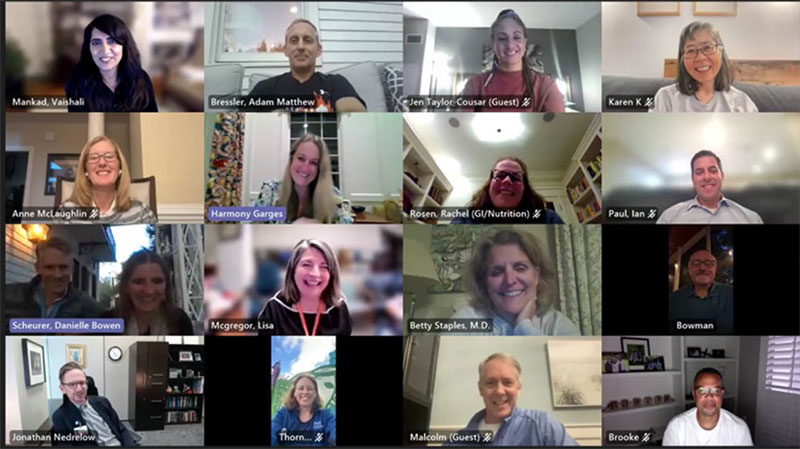
Vaishali Mankad, Adam Bressler, Jen Taylor, Karen Kiang, Anne McLaughlin, Harmony Garges, Rachel Rosen, Ian Paul, Mark Scheurer, Danielle Scheurer, Lisa McGregor, Betty Staples, Brian Bowman, Jonathan Nedrelow, Courtney Thornburg, Bill Malcolm, Brooke Britton. Missing: Ed Evans, Nancy Strom-Morgan, Tania Hurlbutt, Sonia Haugeto
In 10 years, what would you like to solve?
I hope to tackle social determinants of health and child mental health in the next 15 years. We are good at identifying these issues but less good at providing solutions to address them- so I would love to find solutions. It goes back: “What is the evidence behind this?”
Also, in the next 10 years, so many ways things will be changing, like genomics, genetics and multi-omics. How will it impact pediatric care over the next half-century? We are learning more about artificial intelligence (AI), and I anticipate we will have a way to revolutionize what we do, which could be a blessing and a curse.
What advice would you give parents?
The advice I give to parents that I find rewarding are things that Dr. Squire taught me. I love to provide preventive advice to parents, like helping babies sleep through the night or how to teach babies to be less picky eaters.
It is rewarding for me, but it also gives parents the confidence to say, “My baby is a good sleeper” or “My baby is a good eater.” Getting those wins early in the parenting experience makes parents open to working with me as their children get older and have bigger problems. They see this advice as valuable, and good things happen for their family.
What do you do in your free time?
I exercise every day. I do something different to avoid injury, like spinning, team training with weights, or running.
I am an active vegetable gardener. We have a large garden in the backyard. Tomatoes are a big part of our family. I grow them, and my wife, Rita, who is Italian-American, makes the sauce. (Rita worked as a perioperative nurse at Duke and now is a nurse practitioner.)
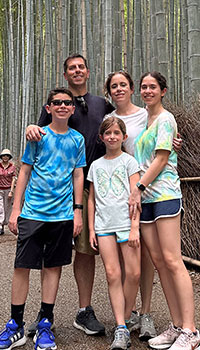
I like to spend time with my wife and three children, 15, 13 & 9. And we like to travel too. We went to Japan for three weeks this summer, and in the years prior, we have gone to northern Italy, Switzerland, and Alaska.
And I am a big Philly and Duke sports fan. (Interviewer note: he was wearing a Duke sweatshirt during the interview and had just been to a Philly playoff baseball game with his 13-year-old. Unfortunately for him, the Phillies did not advance to the 2023 World Series.)
How has being a parent affected you as a pediatrician?
My work has influenced me as a parent. I tried to teach my kids to be good and adventuresome eaters. And they see the work their dad and mom do, their experiences traveling the world and that influences them too. My 13-year-old wants to work as a physician in the World Health Organization doing public health work.
What do you miss from your day in Durham?
Being a resident was a once-in-a-lifetime experience. We were all similar in age and our stage in life. Some of us had kids, some were married, but we were all pulling together in the same direction, and that is what made us such good friends now. We have such a kinship. I miss that closeness we all had as a group.
(Interviewer note: It was a pleasure speaking with Dr. Paul. There were stories about pranks the residents would play on each other, but I will leave that up for him to tell you all about those another time.)